


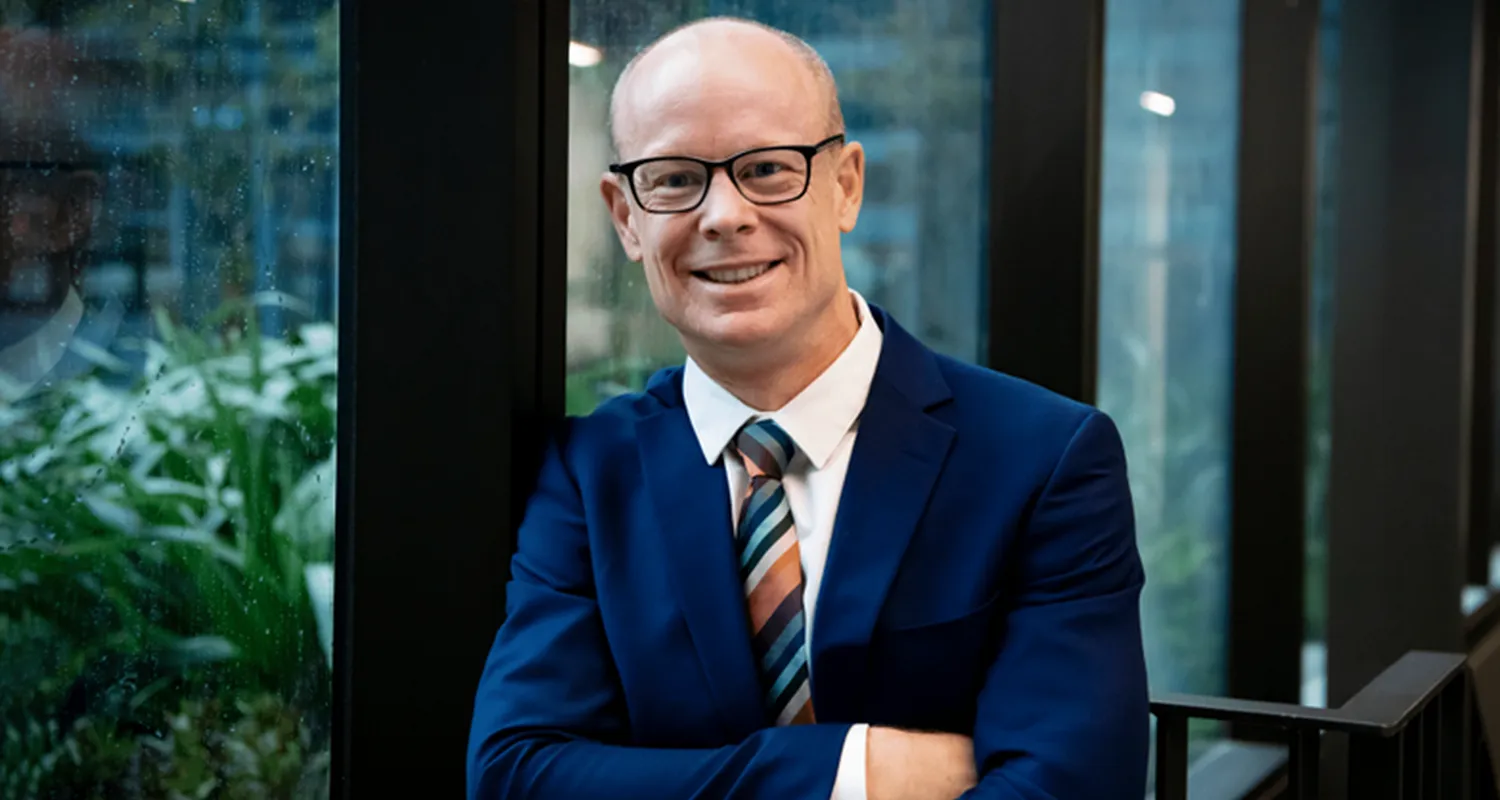
We spoke with Professor Smith about the realities of university leadership, the importance of attracting and retaining talented people, the role of universities in an increasingly complex world, and why he remains optimistic about the future of higher education.
1
Looking back at your time at Victoria University of Wellington, what has surprised you most about the role of Vice-Chancellor, and what have you enjoyed most?
What surprised me most was the generosity of the university community. Even when we faced difficult decisions, including significant restructuring and redundancies, people appreciated honesty and transparency. Universities are sometimes portrayed as individualistic places, but that wasn't my experience. I found a community willing to engage with difficult issues, challenge ideas respectfully, and understand the trade-offs involved.
The part I've enjoyed most is the constant opportunity to learn. Universities bring together experts across an extraordinary range of fields, and I've had the privilege of asking questions and hearing different perspectives every day. Whether it's academics, researchers or students, you're constantly exposed to new ideas, new stories and new ways of seeing the world. It's endlessly interesting and deeply rewarding.
2
You started your career in engineering and research before moving into leadership. How has that background and your international experience shaped the way you lead?
I've always been drawn to different ways of understanding the world. Engineering gave me a foundation for that, and my research work in medicine broadened it further. That interdisciplinary mindset has stayed with me throughout my career and aligns naturally with the breadth of a comprehensive university.
Working internationally has also been incredibly valuable. Different countries and institutions approach challenges in different ways, and those experiences give you a broader perspective on what might work in your own context. Just as importantly, I've been fortunate to work alongside outstanding leaders throughout my career. Mentors have helped me understand a range of leadership strengths and weaknesses, and thus shape how I think about my own role and how best to serve an institution.
3
Universities are facing significant change and public scrutiny. What do you see as the biggest challenge for university leaders today, particularly in New Zealand?
The first challenge is attracting and retaining talented people. Universities succeed because of their people, not their buildings or equipment. As I sat in a leaky prefab on the top of the physiology department at Oxford Uni, we had water coming through the ceiling; so it wasn’t the equipment that made it amazing. It was the people and our capacity to attract talented people from all over the world that made it great. New Zealand universities operate in a highly competitive global market for talent, and that's becoming increasingly difficult.
The second challenge is explaining not just what universities are good at, but what they're good for. Universities aren't simply training grounds for future workers. They are institutions that help society tackle complex, long-term challenges and generate new knowledge, often with benefits that may not be realised for many years. In an environment increasingly focused on short-term outcomes, universities need to do a better job of demonstrating their broader value to society.
4
How can universities create and promote a culture where people feel comfortable sharing different views and ideas?
My view is that universities work best from the bottom up rather than through command-and-control leadership. Accordingly, for me the role of a Vice-Chancellor is to create an environment where people feel confident expressing ideas and challenging accepted thinking.
For academics to play their role as critic and conscience of society, they need to know they'll be supported—not because leaders agree with their views, but because leaders support their right to express them. My expectation is that those conversations are grounded in evidence, conducted respectfully, and approached with humility. I feel very strongly that universities should encourage a wide range of perspectives and create spaces where ideas can be debated openly, thoughtfully and respectfully.
5
What gives you optimism about the future of higher education, and where do universities need to change most?
What gives me optimism is that universities are uniquely positioned to help address many of society's biggest challenges—from climate change and healthcare to education, social cohesion and loneliness. Universities bring together people who think deeply, creatively and over long time horizons, which is exactly what's needed to tackle complex problems.
Where universities need to change is in how they explain their purpose. We need to be clearer and more compelling about the value we create for society. That means being comfortable talking about long-term benefits, even when outcomes are uncertain. If universities can better articulate their contribution and strengthen their connection with the communities they serve, they'll remain one of society's most important institutions.

About Professor Nic Smith
Professor Nic Smith joined Victoria University of Wellington as Vice-Chancellor in January 2023 after holding professorial appointments as the Provost at Queensland University of Technology, Dean of Engineering at the University of Auckland, Head of Biomedical Engineering at King's College London, and Professor of Computational Physiology at the University of Oxford.
He has authored more than 170 peer reviewed journal publications and 350 conference publications. He is also the lead-author on several patent applications for the development of physiological models for specific clinical applications. He is a fellow of the Royal Society Te Apārangi and Engineering New Zealand.